

Einstein once said, ‘We cannot solve our problems with the same thinking we used when we created them’. This saying perhaps forms the very cornerstone- the beginning and the end- of pharmaceutical innovation: a continuous effort to seek new ways of thinking and approaching challenges, often beyond conventional limits, with the aim of providing definitive or optimal solutions to issues that until recently were considered unsolvable. Innovation strives to shape a new reality- one defined by more years of life and, crucially, better years of life- wherever the need is greatest.
Today, this effort is accompanied by significant achievements. A deeper understanding of human biology has made it possible to develop innovative and advanced therapies that address life-threatening diseases in ways once thought impossible. By transforming cells and genes, science now offers hope of cure for conditions where patients previously had no effective treatments. In an ever-expanding range of complex and aggressive malignancies, clinical outcomes are now exceeding historic survival limits, allowing patients to fully reintegrate into family, social, and professional life.
At the same time, individuals with rare or autoimmune diseases are enjoying a quality of life comparable to that of the general population. Patients with Hepatitis C can be cured within three months, making the complete eradication of the virus a realistic global public health goal. People living with HIV are now aging like the rest of the population, without transmitting the virus, while preventive therapy continues to evolve, demonstrating over 95% effectiveness in preventing new infections among high-risk groups. Finally, the rapid innovation behind COVID-19 treatments– developed and made available under conditions of unprecedented difficulty and severe time pressures stood as living proof that investment in pharmaceutical innovation is, in essence, an investment in public health and, ultimately, in the economy itself.
Yet, how is this recognition of pharmaceutical innovation’s contribution to collective and individual health, as well as to the nation’s economic prospects, expressed in practice? Through measures and policies that are often fragmented, lacking ambition, and frequently lost in a sea of regulatory details- sacrificed at the altar of controlling pharmaceutical expenditure alone.
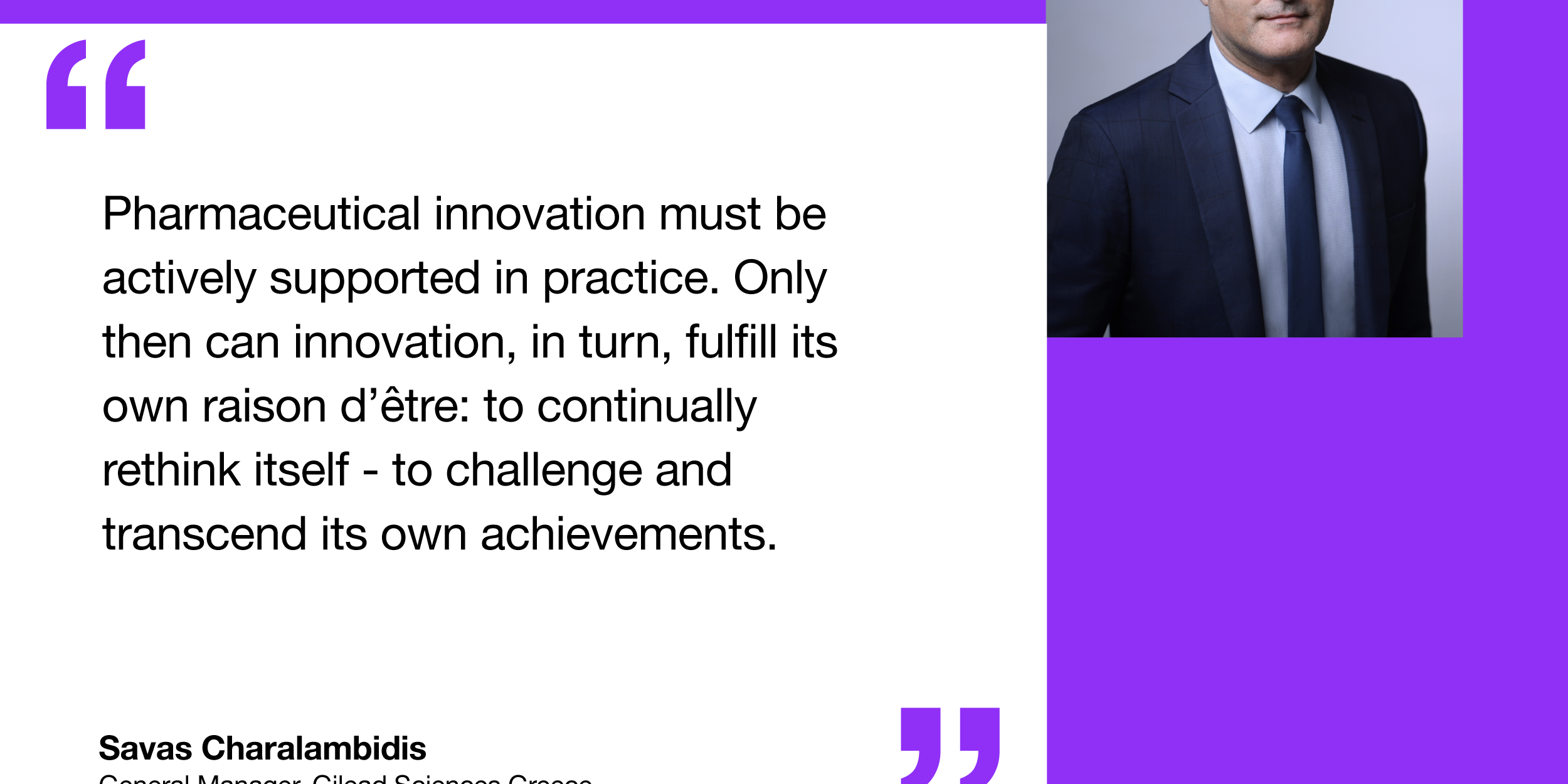
That is why PhARMA Innovation Forum, of which Gilead Sciences is a founding member, remains steadfast in reminding all stakeholders of the true value of innovation. It works to shed light on every aspect of pharmaceutical policy where innovation is undervalued. Through specific, sustainable proposals, the Forum seeks to deliver productive, measurable solutions- starting with small but concrete steps. Guided unwaveringly by the belief that pharmaceutical innovation must not only be recognized in theory but actively supported in practice. Only then can innovation, in turn, fulfill its own raison d’être: to continually rethink itself- to challenge and transcend its own achievements- so that it may bring forth even greater discoveries and surpass its own limits.
Savas Charalambidis, General Manager, Gilead Sciences Greece, Cyprus & European Distributor Markets & PIF VP