


“We want a Europe that does not just legislate, but truly innovates!”
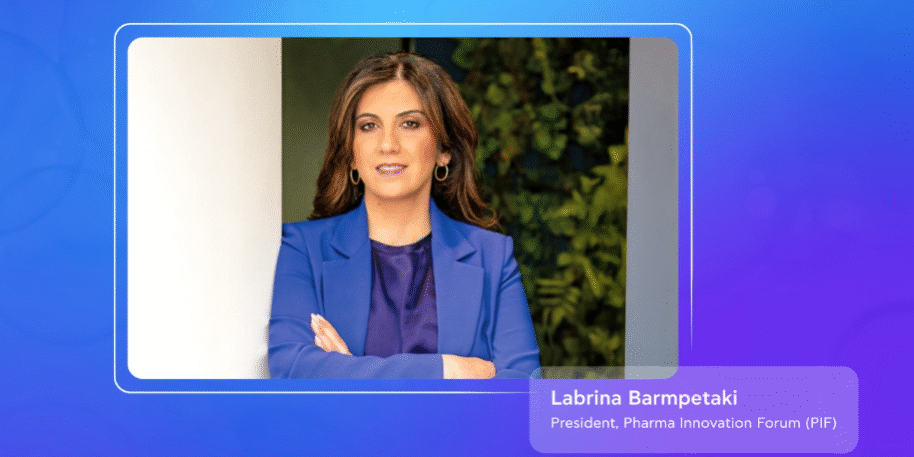
Ms. Labrina Barmpetaki, President of the PhARMA Innovation Forum (PIF), First Vice President of the Hellenic-American Chamber of Commerce, and Managing Director of AbbVie Greece, Cyprus & Malta, placed at the center of the 24th HealthWorld Conference, organized by the Hellenic-American Chamber of Commerce (AMCHAM), the dialogue on the future of the healthcare system in Greece and Europe, highlighting through her interventions both the major challenges and the strategic opportunities ahead of us.
In the discussion with the Minister of Health, Mr. Adonis Georgiadis, and the Chairman of the Medical Devices and Diagnostics Committee of the Hellenic-American Chamber of Commerce, Mr. Spyridon Gikas, she highlighted the pivotal dilemma facing Europe: “Greece and Europe must decide which side of history they will stand on– with bold policies in favor of biopharmaceutical innovation, patient access, and sustainability. We want a Europe that does not just legislate, but truly innovates.” She also emphasized that while the US and Asia are advancing rapidly in research and development, Europe risks falling behind, trapped in its regulatory role. Referring to the Innovation Fund launching on January 1, 2026, she noted that its creation represents a positive first step, but, as she stated, “€50 million is not enough to cover real needs; the question is which treatments are currently being denied to patients and what is the opportunity cost for society”. Regarding the clawback system, she pointed out that Greece occupies an extreme position in Europe, with rates reaching up to 79% for hospital medicines, discouraging investments and clinical studies. She concluded that the only realistic solution is the establishment of a Framework Agreement with the Government.
In a private discussion with former Belgian Minister of Health Maggie De Block, Ms. Barmpetaki highlighted the Belgian “Pact for the Future” as an international benchmark: “Belgium’s example demonstrates that major changes are not theory, but action. The Government, industry, universities, and patients joined forces around a common goal: faster access to innovation and the development of a robust clinical trial ecosystem. This is exactly what Greece needs — an institutional agreement that provides a predictable framework, transparent procedures, and trust. Because the goal is not just to talk about innovation, but to deliver it to our patients promptly and equitably.”
At the panel titled “Reforming with Purpose: A Strategic Plan for Healthcare Transformation”, she emphasized the need for long-term strategic planning: “No country starts with an unlimited healthcare budget; it starts with the political will to decide where to direct the resources it has. The critical question is where we want to invest and what value we want to secure. For me, success is not about numbers or programs, but about giving patients the treatment they need, when they need it. If we don’t do this, we will continue talking about treatments that exist but never reach the patient. And that is not healthcare policy; that is a failure of political decision-making.”
In the discussion with the Minister of Development, Mr. Takis Theodorikakos, and the Chairman of the Medical Devices and Diagnostics Committee of the Hellenic-American Chamber of Commerce, Mr. Spyridon Gikas, she highlighted the strategic dimension of investments in pharmaceutical innovation: “The value of innovation is no longer found only on the production line, but primarily in data, knowledge, and research that generate new treatments and technologies. Greece can take a leading role in this new landscape, provided it creates a stable and predictable environment that attracts both international and Greek investments. We are not talking about production in the traditional sense; we are talking about participation in global knowledge and clinical research ecosystems. This is what will determine whether the country becomes part of the medicine of the future or remains on the periphery of developments.”
Through her statements, Ms. Labrina Barmpetaki highlighted the strategic role of PIF and the pharmaceutical industry as valuable partners of the Government, aiming for a sustainable, competitive, and innovative healthcare system that benefits patients, society, and the economy.