


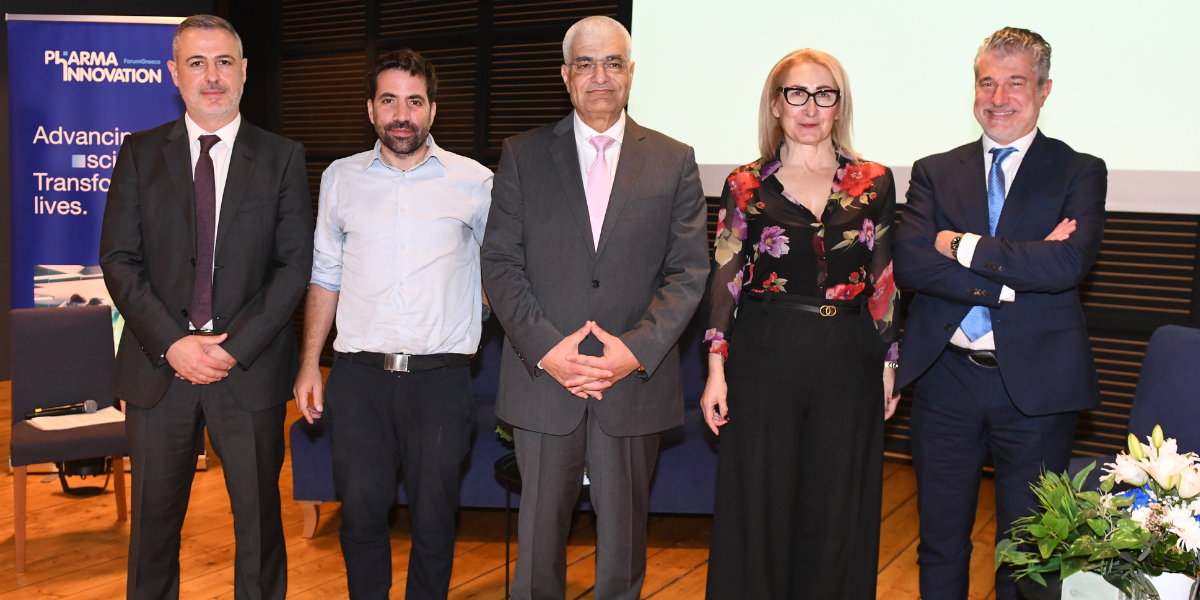
Greece at a critical turning point
Will Greece keep up with pharmaceutical innovation or be left behind?
The event of Pharma Innovation Forum Greece (PIF), held on Wednesday, November 26, highlighted a reality that concerns us all: pharmaceutical innovation is advancing faster than ever. The question is whether Greece can -and wants to- keep up.
PIF President, Ms. Labrina Barmpetaki, emphasized: “Innovation is not a promise for the future. It is here, fundamentally advancing medical practice, transforming healthcare, and changing lives. The issue is not whether we have the knowledge – we do. The issue is whether we have a system that allows patients to access the right treatment at the right time.”
Patient associations and the medical community: the challenge of access to innovative treatments:
In the first session, titled “Evidence-Based Outcomes, Real Needs: The challenge of Access to Innovative Treatments”, moderated by PIF’s General Manager, Mr. Ioannis Kotsiopoulos, participants included Mr. Konstantinos N. Syrigos Professor of Medicine & Medical Oncology, Mr. Charalampos Vlachopoulos, Professor of Cardiology, Mr. Dimitris Kontopidis, President of the European Lung Foundation and President of the Anasa Patient Association, as well as Ms. Foteini Skondra, President of the BoD, Parkinson Union Greece. Evidence was presented demonstrating improvements in patient survival and quality of life in serious chronic diseases over the past decades thanks to innovative treatments.
From the perspective of the medical community, Mr. Vlachopoulos and Mr. Syrigos made it clear: “The country has fallen behind both in patient access times to new treatments and in its attractiveness as a destination for conducting clinical trials. This delay directly affects scientific progress and the options that ultimately reach patients.
Regarding patients, Mr. Kontopidis and Ms. Skondra clearly conveyed: “Only a few can truly benefit from therapeutic progress today.” As was pointed out, “Horizontal measures and clawback mechanisms are not merely accounting exercises – they are matters of life and have real consequences. For a sustainable system to develop for the benefit of patients, a stable framework, prioritization, and substantive reforms are required, because investing in medicine is investing in health, and progress depends on society’s ability to embrace the new, not fear it.”
Myths, truths, and the next chapter of pharmaceutical innovation in Greece:
The second session, titled “Pharmaceutical Innovation in Greece: Myths, Truths, and the Next Chapter,” was moderated by Mr. Ioannis Kotsiopoulos, PIF General Manager, and featured the participation of PIF President Ms. Labrina Barmpetaki, PIF Vice President Mr. Savas Charalampidis, and PIF General Secretary Ms. Elizabeth Prodromou.
The PIF board members addressed the main myths and truths surrounding pharmaceutical innovation. For instance:
Truth #1: Clawback affects patients and their access to innovative treatments.
Only 25% of new treatments approved by the EMA between 2020 and 2023 are fully available in Greece today.
Truth #2: The situation in the pharmaceutical market is worsening.
Clawback reaches 75.5% in hospitals and 63% in EOPYY – levels unprecedented in Europe.
Truth #3: Public pharmaceutical expenditure has remained stagnant for years and below the European average.
Greece is at -12% and -46% compared to Southern and Western Europe, respectively.
Additional examples spoke for themselves: For simple, low-cost treatments, the state covers 100% of the cost throughout the year. In contrast, for serious chronic diseases, coverage drops to just 136 days for a biological psoriasis therapy and only 92 days for oncology immunotherapy. Clinical research is also showing a significant decline: in 2024, the number of studies approved in Greece fell to 118 – a decrease of over 40% compared to 2023 and the lowest level since 2017. Meanwhile, Europe invests more than €47 billion annually in Research and Development, while Greece attracts only €100 million. Aligning with the European average could increase annual investments in Greece to over €500 million, potentially approaching €700 million.
PIF’s Proposals: A Long-Term Solution to the Deadlock
PIF presented three key proposals to help the country break free from the deadlock. A mid-term plan under a definitive agreement to decrease clawback and secure extra funding. Correcting market distortions through a single pharmaceutical budget and state assumption of protective measure costs. Streamlining access procedures and setting up a stable framework for clinical research and value-based assessment.
As a final note, PIF President Ms. Labrina Barmpetaki noted: “The issue is not managing a budget, but creating a system that can provide timely and equitable access to treatments that are already saving lives. Pharmaceutical innovation cannot wait. Greece has choices – the question is whether it will seize them. And this, as discussed at the event, is a challenge we must confront and overcome.


